HOW TO PREPARE FOR AN OCEAN EXPEDITION
Top 10 things to get organised before your next Ocean Expedition
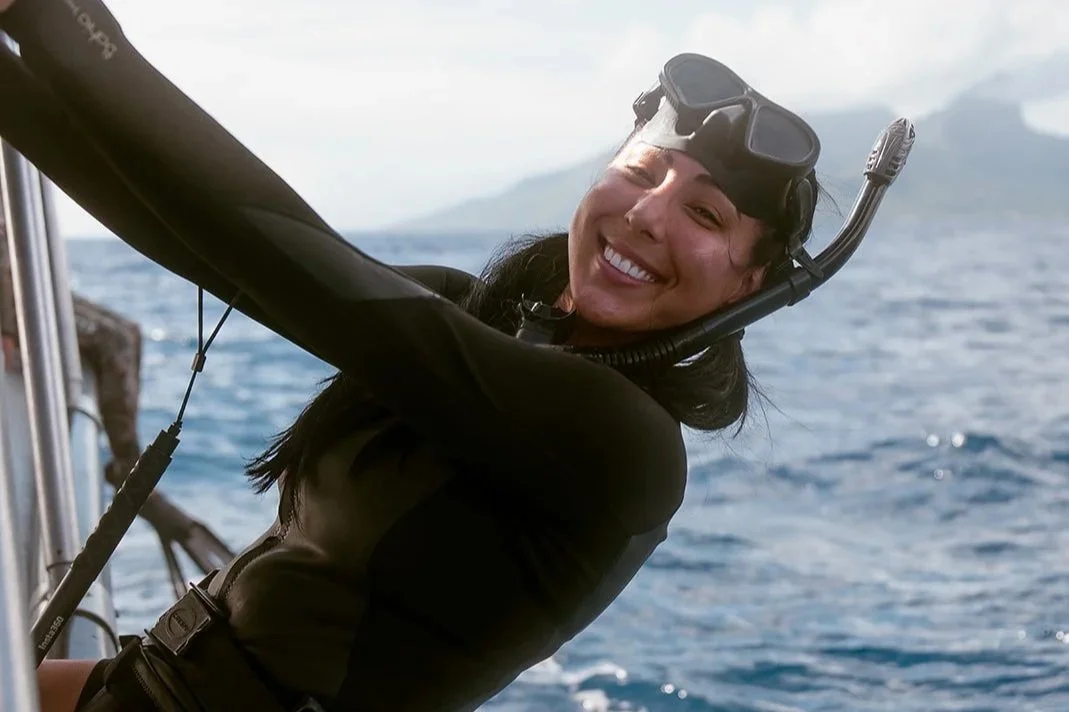
Swim with Whales in Mo’orea, 2025 Expedition
Feeling overwhelmed and don’t know where to start? We’ve got you.
This is what we inform each and every one of our ocean expedition guests - and now you have access too!
We read somewhere that organising yourself is just "over-preparing, so you can go with the flow." That's about right for anything involving wildlife and Mother Nature.
So here's everything. In roughly the order you should do it.
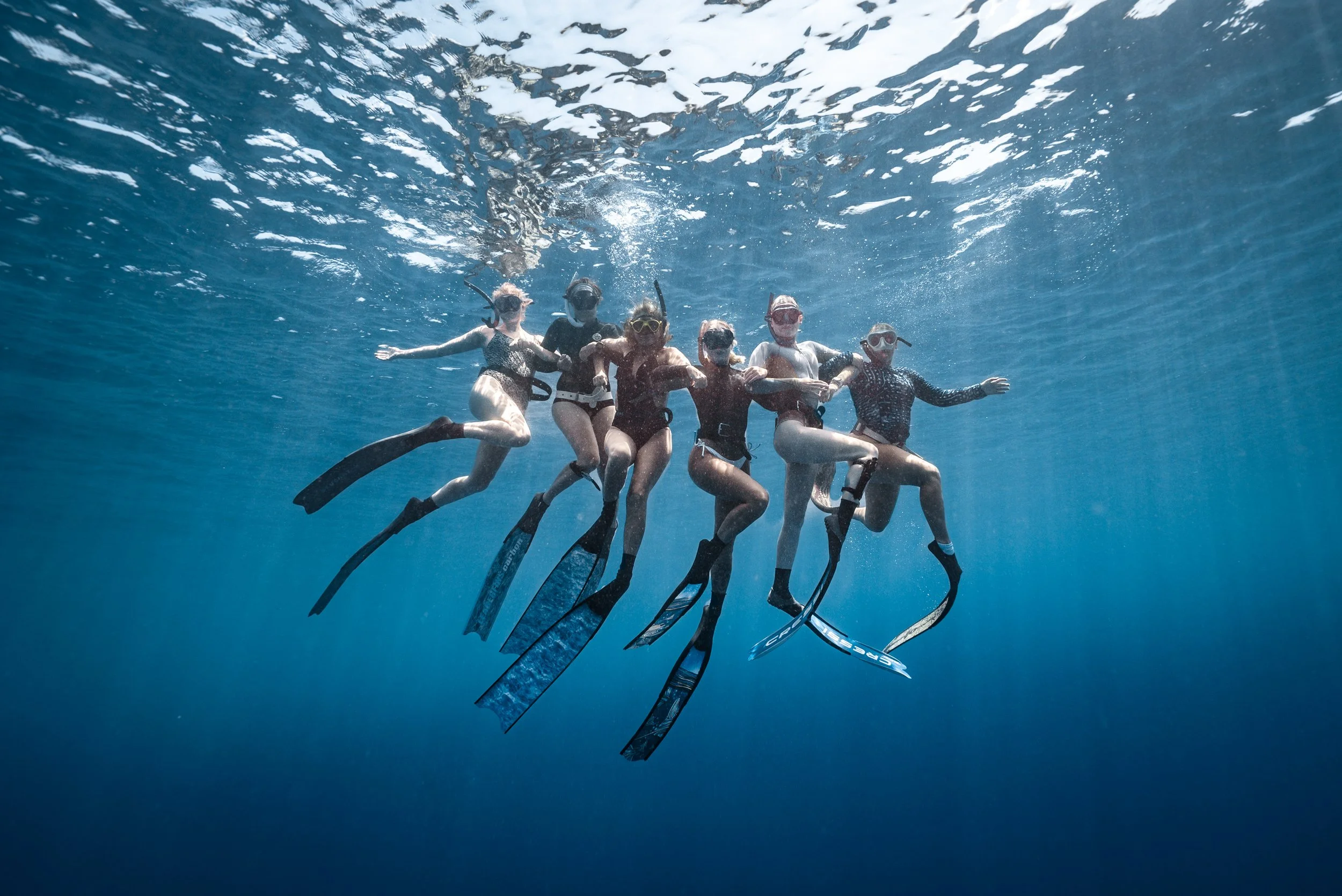
1. Get your gear early, and wear it in!
This is the big one. If you take nothing else from this blog, take this.
New gear straight out of the box on day one of your expedition is how you end up with a leaking mask, blisters on both heels and a very long week of grappling with your wetsuit. Gear needs to be worn in, and you need to be good at putting it on, and taking it off, fast.
Buy it at least 6 months out (or earlier). Then use it. Pool sessions, a snorkel at your local beach, a lap of the bay — anything. You want to know how your mask sits, whether your fins rub, how long your wetsuit takes to get on when you're already a bit cold and over it.
What "good gear" means to us is not expensive gear. It's gear that fits you:
Freediving Mask:
Check out our blog post on ‘Best Freediving Masks' here.
Aim for low volume, and it must seal on your face without the strap tight. Do the suction test in the shop: press it on, breathe in through your nose, let go. If it stays, you're good. A leaky mask will ruin a dive faster than anything else.
Freediving Fins:
Check out our blog post on ‘Best Freediving Fins' here.
Aim for long freediving blades, and the foot pocket is what matters most. Too tight = cramp and blisters. Too loose = you lose them. Try them with the socks you'll actually be wearing.
— great to support your feet over a long week. Bring a spare pair!
Weight belt
Aims for rubber, not nylon. Check whether you can hire them in the location first, and what style they will be!
aaand the Wetsuit
(we’ll get to that next)
In any given moment, you could have less than 10 seconds to get gear-ready before sliding into the water. You don’t want to be fixing a leaky mask or struggling with fins that won’t slide on… meanwhile a 40 tonne whale passes you by.
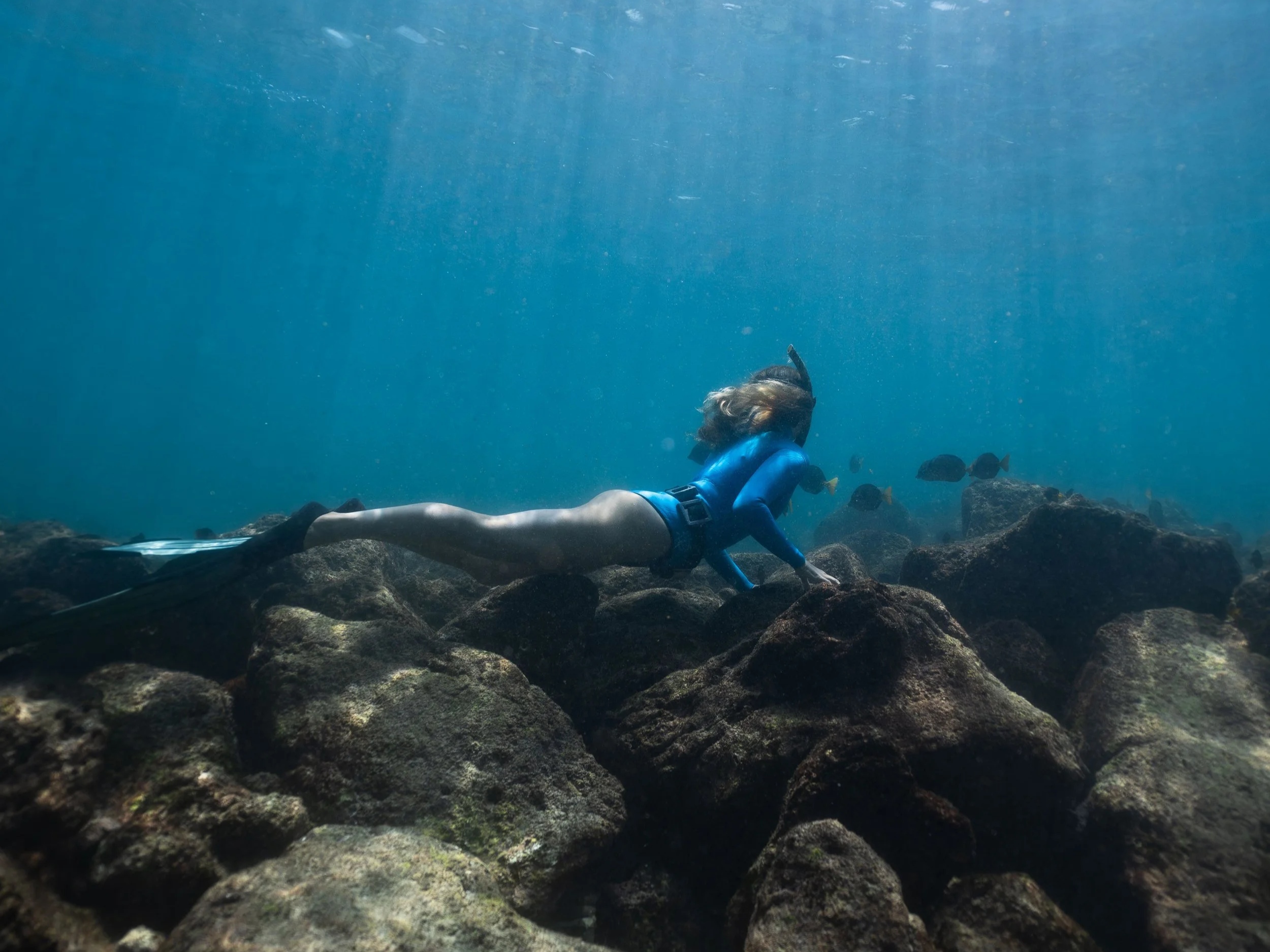
Galápagos Expedition, 2025
2. Invest in a wetsuit you LOVE
On an ocean expedition, you’re going to want to be best friends with your wetsuit.
You’re going to rely on her when you’re wet, cold, and on your 3rd hour in the water. Being uncomfortable changes everything — how long you last, whether you go in for another dive or hang back, and how well you enjoy your moments in the water.
We’ve written a separate blog post on wetsuits for ocean expeditions in warmer climates (for French Polynesia). Most of the brands we recommend offer many wetsuit varieties and thicknesses, so it’s still a good starting place, even if you’re headed somewhere the water might be cooler.
Short version: get the right thickness for the water you're actually going into (ask us if you're not sure — we'll tell you), and make sure it fits snugly with no big gaps at the lower back or neck. If you're someone who runs cold, always get a thicker/warmer wetsuit option.
And wear it in the water before you go. A suit that feels fine in a shop feels different when it's wet.
3. Get your ocean fitness up
The clips you see online with divers swimming with animals often look slow and ethereal. But that’s just ONE moment.
In one day, you could be swimming anywhere between 1-3km in swell, chop and deep water. For example, on our Swim with Whales Expedition, you’ll be swimming a MINIMUM of 100m on every time you ‘drop’ into the ocean from the boat (local law says we can’t be closer than 100m by boat). In one day, we can do anywhere between 1-10 drops per session!
You don't need to be an athlete. You don't need to hold your breath for four minutes. What you need is to be comfortable spending a few hours in the ocean without it wrecking you.
The best training is the most obvious: swim in the ocean. In your gear if you can. Aim for something like 2-3 sessions a week in the 6–8 weeks before you leave, working up to being able to swim comfortably in your full gear for 20+ minutes continuously.
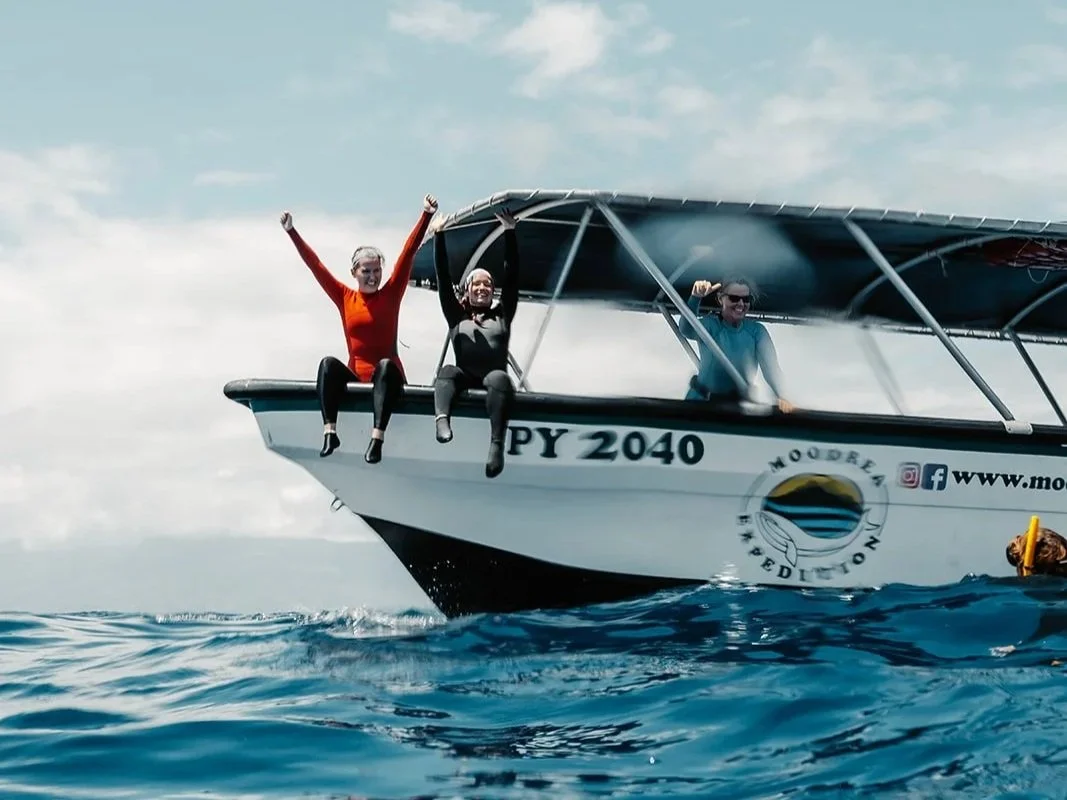
4. Test your sea sickness pills before you go
Boat days are long. Even people who "don't usually get seasick" sometimes do when they're anchored in swell, looking down at a phone, in the sun, on four hours' sleep.
If you’re unsure, you may want to bring some pills anyway. You can get some more natural ones if you’re not a huge fan of meds.
Get your medication sorted before you fly, not at the pharmacy in a small island town at 7am.
Try it at home first so you know how it makes you feel — some options make people drowsy, which is its own problem on a big day.
Talk to your doctor or pharmacist about what suits you, especially if you're on other medication.
Bands, ginger, sitting at the back, eyes on the horizon — all worth having in the arsenal whilst you’re on the boat. But having some Kwells in your back pocket could be the difference between a smooth ride or hurling over the side of the boat and missing out on some whale drops.
5. Pack for the mini-emergencies
The big emergencies are rare; the small ones aren’t. Packing for these mini-mergencies will save the day, seriously!
Think along these lines:
Band-aids and blister patches (bring more than you think)
Anti-fog, or baby shampoo
Hair ties. So many hair ties. They vanish.
Warm clothes — a warm waterproof jacket, dry clothes, trackies, a jumper. You get cold after the water, not during, and boats are windy.
A proper towel and a dry change of clothes in a dry bag
Reef-safe sunscreen and zinc, plus a wide-brim hat and a long-sleeve rashie. We're big fans of People of the Earth — use the code MERMAIDSOFTHEEARTH at checkout!
Lip balm with SPF
Any personal medication, in your carry-on
Electrolytes or hydration tablets. We use SODII
A spare mask strap and a spare pair of socks
A power bank and the right adapter
If you're heading somewhere remote: bring cash, assume the pharmacy doesn't exist, and don't count on the wifi.
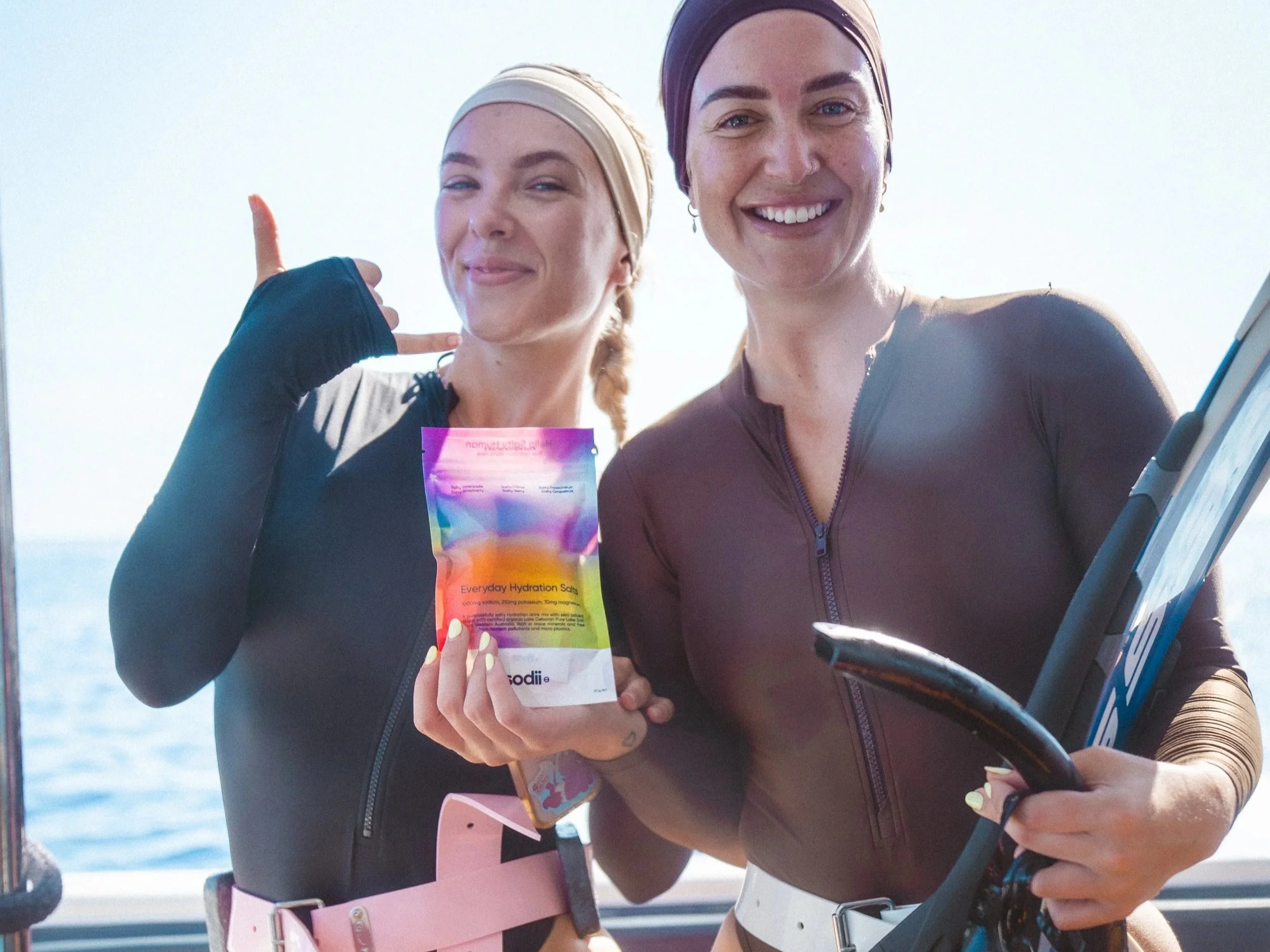
The girls with their SODII Electrolytes, Freedive with Tiger Sharks in the Maldives Expedition, 2025
6. Get travel & dive insurance!
It’s so boring until it isn’t.
Get travel insurance. Then check it actually covers what you're about to do.
A lot of standard policies exclude freediving, breath-hold diving, or any "underwater activity" outright. Some cover snorkelling but not freediving. Some cover it only to a certain depth, or only with a certificate.
Things to actually check with your insurer, in writing:
Does it cover freediving / breath-hold diving specifically?
Does it cover emergency medical evacuation? This matters enormously. If we're somewhere without a hospital — and on some of our expeditions we are — getting you to one is a private charter or a plane, and the bill for that is the kind of number that changes lives.
Does it cover trip cancellation and delays? Weather moves. Flights get missed.
Does it cover your gear, if it's lost or damaged in transit?
Are there age limits or medical exclusions that apply to you?
A lot of our guests often purchase one comprehensive dive insurance that also covers travel. Dive Assure and Divers Alert Network (DAN) are the one a lot of our guests end up with. If you’re opting for Dive Assure, you can purchase a policy through our unique partner link here.
Other guests who don’t dive consistently enough, prefer to go for two separate policies for one trip: one for diving and one for travel.
We're not insurance brokers and we can't tell you which policy to buy. But we can tell you that "I assumed I was covered" is a sentence we never want to hear from you.
7. Knock over the other boring admin early
Do this early, in one sitting, and never think about it again! Woohoo:
Passport — six months validity beyond your return date, minimum. Check it now, not in November.
Visas — check the requirements for your destination and your passport. Some are on arrival, some very much aren't.
Country-specific entry requirements — some destinations require entry fees in cash only, for example. Just make sure you’re across it early!
Medical forms and waivers — most operators (especially us) require you to sign some a waiver or two, including a medical waiver. If you’re on a trip with us, you’ll be asked to declare any medical matters (e.g. medication, recent surgery or illness etc.), as well as provide a doctors note that clears you to participate.
Tell your bank you're travelling, and take a backup card!
Organise an eSim so you can use internet or make calls in-country. We often use Airalo.
8. Purchase sun protection you'll actually want to use
A boat is the harshest sun environment there is. It’s the perfect storm: no shade, 4-5 hours of it, and the water throwing it straight back up at you. People who never burn at home get cooked out here!
Essential: reef-safe and mineral-based SPF (we're swimming in the thing you're washing it into), applied 20 minutes before you get on the boat, and reapplied more often than you think.
But the real trick is this: you will not reapply sunscreen every 90 minutes for a week. You will, however, keep wearing a hat you like.
So the best sun protection is the stuff you actually want to put on:
A wide-brim hat with a chin strap. The strap is not optional — boats are windy, and a hat without one is just a gift to the ocean. Yes, they look a bit daggy. Everyone's wearing one by day two.
A cover-up or sarong. The most useful thing in your bag — over your shoulders on the boat, wind layer when you're wet and cold, something to throw on for a village stop, and a towel in a pinch.
Zinc on your nose, cheeks, ears and the tops of your feet. (Feet burn in socks and fins. Nobody expects it. Everybody regrets it.)
SPF lip balm. Burnt lips for six days is its own special misery.
Sunglasses with a floaty strap, unless you'd like to donate them to the ocean gods!
Sunburn also makes you cold. Burnt skin loses heat faster, so day one's sunburn becomes day two's shivering and day three of getting out of the water early.
Where we get ours: we're big fans of People of the Earth — sun-safe gear that doesn't look like sun-safe gear, and made properly. Use the code MERMAIDSOFTHEEARTH at checkout for a discount, and it sends a little something back our way too. 🌟
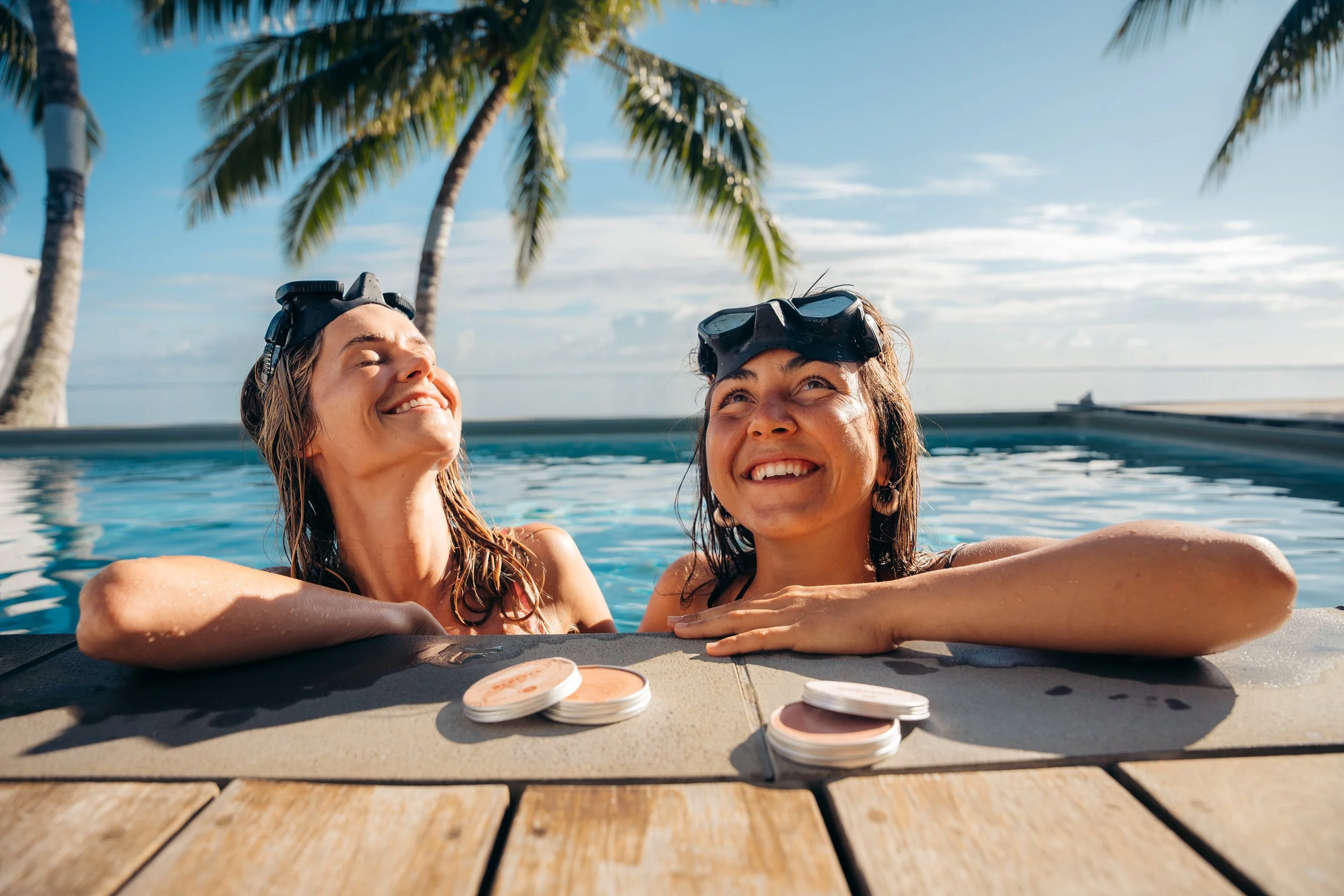
Bella and Micol with their People of the Earth Merface SPF Pots, Swim with Whales in Mo’orea Expedition, 2026
9. Organise your camera set-up
If you're bringing a camera: charge everything, bring spare batteries and cards, and know how to work it in the water before you go. Fiddling with settings while everyone else is having a moment is a specific kind of frustration.
If you're not: good. Someone else will be shooting, and we'll share!
10. Come with the right expectations
This is wildlife, in the open ocean, on nature's schedule. We don't control the weather, the swell, or where the animals decide to be that morning.
Some days are quiet. Some days everything happens at once. Nobody can control nature, but you can control how you react to what’s in front of you.
Choose positivity.
The guests who have the best time are the ones who came for the whole thing — the boat rides, the people, the bad jokes, the ocean — and treated the encounters as the incredible bonus they are.
What if the whales don’t show up?
What if you missed ‘the shot’?
What if someone bumps into you by accident?
Are you heading home grumpy and complaining? or grateful and smiling!
We ask our guests to choose their mindset at the start of the week. Or even as early as a few months before the trip. It makes a huge difference.